Welcome to the Hardcore Husky Forums. Folks who are well-known in Cyberland and not that dumb.
Let's talk labor participation rates
Comments
-
Yeah, ignore the bulk of the work force to comment on kids that have to stay in school and run up debt because there are no jobs for them (i.e. won't show up in the stats you showed) along with people 55+ that either can't now afford to retire or have to come back into the workforce because the economy has been crappy (hey, look old people working is going up...you should gurgle Obama some more).
But hey, I heard Walmart greeters are getting a pay raise so maybe median income won't continue to fall under Obama?
Keep *Gurgling* -
The chart does a good job of showing how Medicare costs are decreasing by comparing it to private payors, but it is missing the third major payor in the US: Medicaid. Medicaid represents 15.5% of all US health care costs and has been steadily increasing since 1980 (vs Medicare which is 20.5% and private insurance which is 32.8%).2001400ex said:
It's been a while since I took a college stats class, but this growth does not appear to be exponential.Fire_Marshall_Bill said:Decreasing wages, exponentially higher healthscare costs
http://m.whitehouse.gov/blog/2014/09/05/chart-week-health-care-costs-rising-exceptionally-slow-rates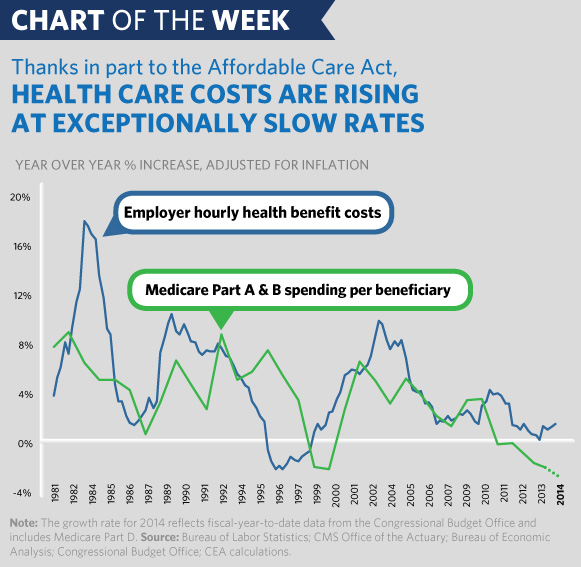
One of the biggest changes with the ACA is how CMS restructured payments to hospitals and forced hospitals to modernize and improve coordinating services to improve health outcomes. One of the most notable changes is reducing the amount of payment a hospital receives if a patient is readmitted within 30 days of discharge and other important quality measures. This helps explain why there is such a significant deviation from the private payors from about 2011 onward. However, one of the things to consider with this chart is that it does not capture costs associated with other health insurances (Medicare C, Medicaid), out-of-pocket spending, or long-term care (only the first 100 days after hospital discharge) in these populations.
Overall US health care costs (as well as health outcomes) would be more appropriate and interesting to look at.


