College Football Playoff: Winners, losers from bracket reveal and bowl selection day


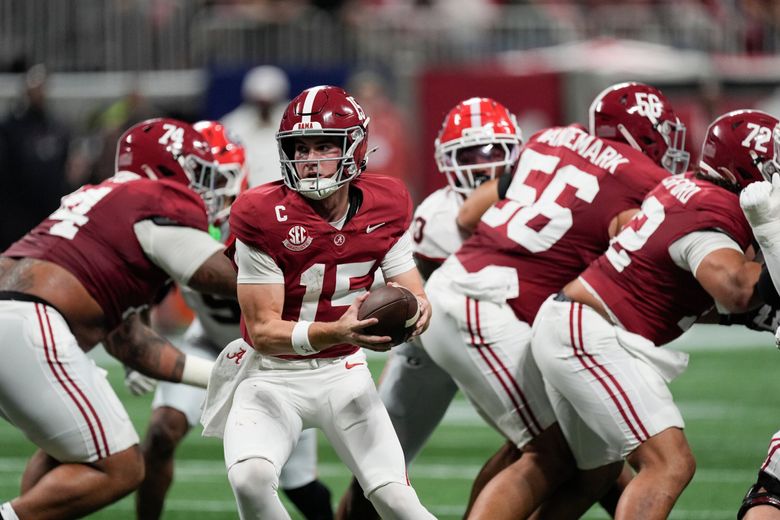
Alabama quarterback Ty Simpson (15) works against against Georgia during the first half of a Southeastern Conference championship NCAA college football game, Saturday, Dec. 6, 2025, in Atlanta. (AP Photo/Mike Stewart)... (Mike Stewart / The Associated Press)

By Jon Wilner Bay Area News Group
Whether it was intentional or not (probably not), the College Football Playoff selection committee ultimately acted out of self-preservation Sunday with the reveal of the 2025 field generally and the seven at-large teams specifically.
Alabama made the cut with the No. 9 seed.
So did No. 10 Miami.
They were the final two at-large teams selected but, by far, the most important — not because they necessarily deserved bids at the expense of Notre Dame but because of the collateral damage that would have accompanied their exclusion:
— Had Miami been ranked behind the Irish even though their résumés were comparable and the Hurricanes won the head-to-head matchup, the committee would have lost immense credibility. What’s more, many powerhouse schools would have reconsidered the high-profile duels that energize the season’s opening weeks. (Why risk a loss when a victory doesn’t matter?)
— Had Alabama been knocked out of the field for losing the SEC championship game to Georgia after the Crimson Tide beat the Bulldogs during the regular season (in Athens, no less), the committee would have placed its own existence in jeopardy.
After all, the committee serves at the discretion of the FBS commissioners and, in particular, the SEC’s Greg Sankey and the Big Ten’s Tony Petitti, who control the format for the CFP starting next year.
Both commissioners are skeptical of the selection process by nature and experience. Excluding the No. 1 seed in the SEC championship but including three teams (Texas A&M, Mississippi and Oklahoma) that did not qualify for the game might have created a DEFCON 1 situation at SEC HQ.
Advertising Skip AdSkip AdSkip Ad
In this case, the end justifies the means, even if the means were messy and confusing, stocked with contradictions and obfuscation.
With the choice to include Alabama and Miami and exclude Notre Dame, which doesn’t have a conference, the committee opted to value head-to-head results and regular-season success — two pillars of the sport’s competitive process.
This was the best bracket for the committee to ensure that the committee endures, so let’s consider it one of the biggest winners from selection day.
Here are others, along with an equivalent number of losers …
Winner: The SEC. The conference collected five bids — two more than its rival, the Big Ten — to satisfy a membership ravenous for bids after the 2024 selection process did not unfold as planned. Commissioner Greg Sankey’s offseason push for more emphasis on schedule strength and quality wins worked as designed … unless you’re Texas and Vanderbilt.
Loser: Notre Dame. The head-to-head loss to Miami only became the final straw because Notre Dame’s schedule was heavy on lightweights. Had the Irish beaten one or two more ranked teams, they would not have been paired in a résumé showdown with the Hurricanes in the first place. It’s the blessing and the curse of Notre Dame’s scheduling partnership with the weak ACC. Regardless, the Irish were so upset about the exclusion that they declined a bowl invitation.
Winner: The new Pac-12. The future conference’s bowl-eligible teams drew several juicy assignments, including Boise State’s duel with Washington in the LA Bowl and Washington State against Utah State as an intra-conference matchup in the Potato Bowl.
Advertising Skip Ad
Loser: Washington. Had we informed UW fans on Aug. 30 that the Huskies would win eight games and finish the season in SoFi Stadium against the Mountain West champion, many likely would have shrugged. Had we given fans that same endgame on Oct. 30, when UW was 6-2, they would have curled up in the fetal position.
Winners: CFP expansion proponents. Unlike last year, which produced a weak bubble, several worthy teams were left out of the 2025 field. The list starts with Notre Dame but includes Texas and Vanderbilt, as well. The CFP management committee has approximately six weeks to decide whether to expand the field to 16 teams for 2026.
Loser: The Big Ten. The conference’s top-heavy, middle-light nature was evident all season and exposed for the world to see by the committee rankings: Indiana, Ohio State and Oregon grabbed three of the top five seeds, but that’s it. There are no other Big Ten teams in the field.
Winner: The Big Ten. Unless Oregon loses to James Madison, the conference is guaranteed to have three quarterfinalists. At least two, and perhaps all three, will be favored to advance to the semifinals.
Loser: Weekly CFP rankings. The Notre Dame-Miami situation, in which the Irish were ranked above the Hurricanes for five weeks before they flipped positions after both were idle, exposed ESPN’s weekly shows for the sham they are.
Winner: ESPN. Those same rankings serve the network’s purpose brilliantly, placing it at the narrative center of the second-most popular sport in the country for more than a month.
Advertising Skip AdSkip AdSkip Ad
Loser: Rematches. The opening round will feature two repeats from the regular season with Alabama-Oklahoma and Mississippi-Tulane. To a certain extent, rematches are unavoidable with a 12-team field. But we support the committee tweaking the process to limit 2.0s to the greatest extent possible.
Winner: The Group of Five. When the current format was crafted a few years ago, few could have reasonably foreseen a scenario in which the collection of second-tier conferences would snag two bids and one power conference champion would get shoved aside. But for the sake of G-5 credibility, either Tulane or James Madison needs to show it belongs.
Loser: USC. Another playoff without the Trojans — that’s 12 in a row, if you’re scoring at home. More stunning: Indiana has qualified for the CFP twice before USC makes its initial appearance.
Winner: The Billionaire Bowl. Assuming Oregon beats James Madison in the opening round, the Ducks will advance to face No. 4 Texas Tech in the quarterfinals, a matchup of well-funded rosters courtesy of Phil Knight and Cody Campbell.
Losers: Mississippi and Texas A&M. Once it became clear Ohio State and Georgia would be the No. 2 and 3 seeds paired on the same side of the bracket, the No. 6 and 7 spots emerged as the toughest for the four at-large teams hosting opening-round games. Good luck to the Rebels and Aggies with those twin behemoths looming in the quarterfinals and beyond.
Winner: The ACC. The image hit that comes with its champion (Duke) missing the playoff isn’t nearly as great as the optical nightmare that would have emerged if Miami had not squeezed into the field. In this instance, the lesser of two evils is a massive victory for the beleaguered conference.
Sponsored
Skip Ad Skip Ad Skip Ad Skip Ad
Loser: BYU. Yes, the Cougars were punished for the blowout loss to Texas Tech in the Big 12 championship, while Alabama was not dinged for its lopsided loss to Georgia in the SEC version. But those situations aren’t apples-to-apples. The Crimson Tide lost to an opponent it defeated on the road earlier in the season; the Cougars were spanked twice by the Red Raiders (combined score: TTU 63, BYU 14). Despite all the outcry, the Cougars’ case for inclusion was fairly weak.
Winner: Indiana. The Hoosiers edged Ohio State in the Big Ten championship game to claim their first conference title since 1967 and the No. 1 seed, thereby dropping the Buckeyes into the No. 2 spot and a semifinal matchup against Georgia that could be the best game of the tournament.
Loser: Losses. The committee announced in August that changes to the selection process would reduce the impact of quality losses, then didn’t follow its own guidelines: Nine of the top 10 teams are ranked in order of losses. The exception is Alabama (10-3), which finished ahead of Miami (10-2).
Winner: The NFL. The playoff networks and time slots speak volumes: ESPN farmed out (to TNT) the opening-round games (Tulane-Mississippi and Oregon-James Madison) that run concurrently with the NFL broadcasts on Dec. 20 and scheduled the best matchups (Oklahoma-Alabama and Miami-Texas A&M) for slots that are unopposed.
Loser: Penn State. From No. 2 in the preseason rankings to an interim coach, the Nittany Lions (6-6) could never have scripted the season that unfolded. The Pinstripe Bowl, against preseason No. 4 Clemson, is an appropriate destination.
Winner: Las Vegas Bowl. A solid matchup with Utah facing Nebraska could turn into appointment viewing if Utes coach Kyle Whittingham announces the game will be his last, which is certainly our expectation.
Advertising Skip Ad
Loser: Texas. CFP exclusion is just one component of a ghastly situation for the Longhorns, who must endure watching their rival (Oklahoma) and their other rival (Texas A&M) and their second-tier rival (Texas Tech) all participate in the playoff. The football gods designed a special place in postseason hell for Texas.
Winner: Cure Bowl. The matchup of South Florida and Old Dominion stands as an under-the-radar gem within the pre-Christmas lineup.
Loser: Orange Bowl. The presumptive showdown featuring No. 5 Oregon and No. 4 Texas Tech matches teams from distant campuses that lack large alumni bases in South Florida.
Winner: The Hawaiʻi Bowl. It doesn’t get much better for bowl executives than a visiting team (Cal) whose starting quarterback (Jaron Keawe-Sagapolutele) grew up 24 miles from the stadium.
Jon Wilner: jwilner@bayareanewsgroup .com. Jon Wilner has been covering college sports for decades and is an AP top-25 football and basketball voter as well as a Heisman Trophy voter. He was named Beat Writer of the Year in 2013 by the Football Writers Association of America for his coverage of the Pac-12, won first place for feature writing in 2016 in the Associated Press Sports Editors writing contest and is a five-time APSE honoree.